
The AI
Transformation
Journey
A clear, practical, seven-stage pathway to becoming an AI-enabled organisationbuilt from real-world work with hundreds of teams.
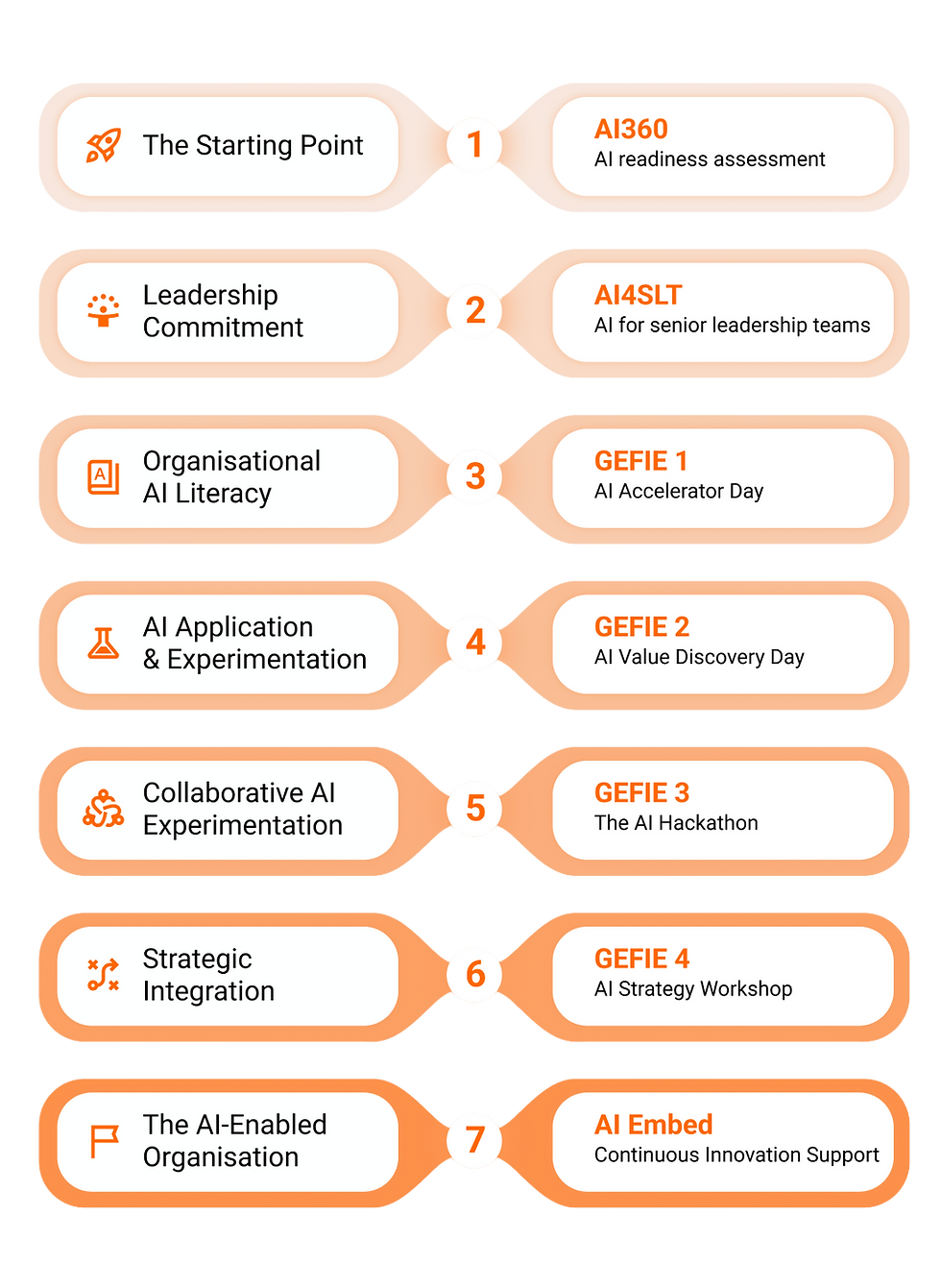
This framework is the foundation of the Dixon AI Transformation Programme, accelerated through interventions such as AI4SLT, GEFIE 1–4 and AI Embed.
%20-%20Edited.png)
A proven,method for AI transformation
Dixon AI’s Transformation Playbook is the result of three years of applied work with organisations adapting to the post-2022 AI environment. Since the launch of ChatGPT on 30 November 2022, the operating model for organisations has changed irreversibly. Transformation now depends on capability, literacy and adaptability—not just technology.
The Playbook captures a seven-stage model that reflects how real organisations progress:
from awareness → literacy → experimentation → embedding → continuous innovation.
This framework is the foundation of the Dixon AI Transformation Programme, accelerated through interventions such as AI4SLT, GEFIE 1–4 and AI Embed.
.png)
Each stage builds on the last, ensuring your organisation moves at pace while maintaining alignment, clarity, and momentum. No technical background is required - just a commitment to learning and progress.
Whether your teams are early in their AI learning or already experimenting, GEFIE meets them where they are and moves them forward together.


The Seven Stages of AI Transformation
Stage 1: The Starting Point
Recognising the shift from the pre-2022 world
Most organisations begin with structures, processes and leadership models designed for a more predictable era. This stage is about acknowledging that the external environment has changed and that traditional approaches to strategy, planning and learning no longer keep pace.
This awareness sets the foundation for everything that comes next.
Stage 2: Leadership Commitment
Creating alignment and permission to explore
Transformation cannot begin until leaders understand the implications of AI and give clear permission for safe experimentation. This stage aligns senior decision-makers around a shared language, vision and mindset. Leadership moves from restricting AI use to enabling exploration, reducing fear and signalling cultural readiness.
Stage 3: Organisational AI Literacy
Building shared understanding and confidence
Once leadership is aligned, the organisation must build foundational literacy: what AI is, how it works, what it can and cannot do. This stage develops a common language across teams, removing guesswork and equipping people with the skills to start experimenting meaningfully.
It transforms AI from a buzzword into something people feel safe and able to use.
Stage 4: AI Application & Experimentation
Creating alignment and permission to explore
Applying literacy to real work with a strong baseline of understanding, individuals begin using AI purposefully within their own roles. People start building simple prompts, workflows and use cases that improve their daily tasks.
This stage is where curiosity turns into real value the first small wins that prove what AI can do.
Stage 5: Collaborative AI Experimentation
Scaling value through teamwork
As individuals gain confidence, teams start to collaborate on AI ideas that span departments or processes.
This stage connects early experiments, encourages cross-functional problem-solving and generates prototypes that demonstrate broader organisational value.
AI becomes a shared capability, not an isolated act.
Stage 6: Strategic Integration
Embedding AI into strategy, governance and operations
Here the organisation formalises what it has learned. AI becomes part of business-as-usual, integrated into planning cycles, decision-making, governance, policies and capability development.
The organisation shifts from experimentation to structured, strategic adoption that aligns directly with core objectives.
Stage 7: The AI-Enabled Organisation
Becoming adaptive, innovative and continuously evolving
In this final stage, the organisation develops the ability to learn, experiment and integrate new AI capabilities continuously.
AI is no longer a project; it’s a stable organisational capability.
Teams create, share and refine AI-enabled ways of working as part of their daily rhythm, allowing the organisation to innovate at the pace of technological change.
Why the Dixon AI Transformation Model Is Effective
Capability over control
Transformation succeeds when people are enabled not when tools are imposed.
This model starts with literacy, confidence and permission.
A structured learning rhythm
Get Urgent → Explore → Formulate → Iterate → Embed (GEFIE) creates momentum and psychological safety.
Real work, not theory
Every stage produces reusable assets, prototypes and strategic structures you adopt immediately.